
Hey there, network warriors! If you’re gearin’ up for a big interview in the networking world, you’ve probably got “DHCP interview questions” on your brain And lemme tell ya, nailing these questions can be the difference between landing that dream job and walkin’ away empty-handed. I’ve been there, sweatin’ through tech interviews, and I’m here to help you ace this topic with confidence At our lil’ corner of the internet, we’re all about breakin’ down complex stuff into bite-sized, easy-to-get chunks. So, grab a coffee, and let’s dive into Dynamic Host Configuration Protocol (DHCP)—what it is, why it matters, and how to tackle those tricky interview questions like a seasoned pro.
What’s DHCP, and Why Should You Care for Interviews?
Before we get into the nitty-gritty of interview Qs, let’s make sure we’re on the same page. DHCP, or Dynamic Host Configuration Protocol, is like the unsung hero of any network. It automatically hands out IP addresses and other network settings to devices—think laptops, phones, printers, you name it. Without DHCP, you’d be stuck manually settin’ up every single device, which ain’t gonna fly in today’s fast-paced, massive networks.
Why’s this critical for your interview? ‘Cause employers wanna know you can handle the backbone of network ops. Whether you’re gunnin’ for a CCNA, CCNP or even a CCIE certification DHCP is a must-know. It touches on scalability, security, and troubleshooting—stuff every networking gig deals with daily. So, when an interviewer hits you with a DHCP question, they’re testin’ if you can keep their systems runnin’ smooth.
Let’s break this down and prep you with the most common and tricky DHCP interview questions, straight from the trenches I’ll explain each concept simple-like, toss in some answers, and give ya tips to shine Ready? Let’s roll!
The Basics: Start Strong with DHCP Fundamentals
Interviewers often kick off with the easy stuff to see if you’ve got the foundation locked down. These questions ain’t just warm-ups—they’re your chance to show you ain’t a rookie. Here’s what you might face and how to answer ‘em.
-
What exactly is DHCP, and what problem does it solve?
DHCP is a network protocol that automates givin’ out IP addresses and other config details to devices on a network. It solves the headache of manually settin’ up IPs, which is a nightmare as networks grow. Imagine a company with hundreds of devices—without DHCP, you’d be typin’ IPs till your fingers fall off!
Tip: Keep it short, mention automation and scalability. Show you get why it’s a big deal. -
Which transport protocol does DHCP use, and why’s that?
DHCP runs on UDP, a connectionless protocol. Why? ‘Cause it’s lightweight and works for broadcast messages when a device don’t even have an IP yet. It’s all about speed and simplicity at that stage.
Tip: Drop “connectionless” and “broadcast” to sound sharp. Explain it like you’re teachin’ a buddy. -
What ports does DHCP use?
It’s UDP port 67 for the server and UDP port 68 for the client. Easy to remember—server’s the boss on 67, client’s askin’ on 68.
Tip: Memorize these. Messin’ up basic numbers looks sloppy. -
Is DHCP a Layer 2 or Layer 3 protocol?
Technically, it’s an application-layer protocol, sittin’ on top of UDP (Layer 4) and IP (Layer 3). But here’s the kicker—it starts with Layer 2 broadcasts ‘cause the client don’t got an IP address yet.
Tip: Show off by mentionin’ the broadcast bit. It proves you understand the process.
These basics are your bread and butter. I remember flubbin’ a port number question once—don’t be me! Nail these, and you’ve set the tone that you know your stuff.
Diggin’ Deeper: Understandin’ the DHCP DORA Process
Now we’re gettin’ into the meat of DHCP—how it actually works. Most interviews will test if you get the operational side, and the DORA process is a fan favorite. Let’s break it down so it sticks.
-
Can you explain the DHCP DORA process?
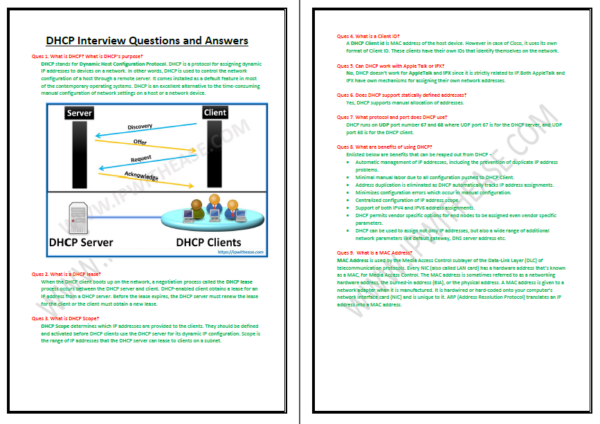
DORA stands for Discover, Offer, Request, Acknowledge. It’s the handshake between a client and server to get an IP address. Here’s how it goes:- Discover: The client broadcasts a message sayin’, “Hey, I need an IP! Who’s out there?”
- Offer: A DHCP server replies with, “I gotcha, here’s an IP and some settings.”
- Request: The client says, “Cool, I’ll take that IP, let’s lock it in.”
- Acknowledge: The server confirms with, “All good, it’s yours for now.”
This keeps IP assignment clean and conflict-free.
Tip: Use simple words or analogies (like “handshake”). If you can sketch this on a whiteboard, even better—shows you visualize concepts.
-
Why does DHCP use broadcasts at first?
When a device boots up, it’s got no IP or clue where the server is. Broadcastin’ ensures the request hits every corner of the local network till a server responds. It’s like yellin’ in a crowded room till someone answers.
Tip: Highlight the “no IP yet” part. It’s a small detail that shows depth. -
What if multiple DHCP servers reply with offers?
The client usually grabs the first valid offer it gets and ignores the rest. That’s why network design and security gotta prevent rogue servers from buttin’ in.
Tip: Mention security briefly—it hints you think bigger.
I’ve seen folks trip up on DORA ‘cause they memorize the steps but don’t get why each happens. Don’t just parrot—explain it like you’ve set up a network yourself.
Lease Management: Show You Know the Lifecycle
DHCP ain’t just about givin’ out IPs; it’s about managin’ ‘em over time. Interviewers might toss in lease questions to see if you understand resource allocation.
-
What’s a DHCP lease lifecycle?
A lease is how long a device gets to keep an IP before it’s up for grabs again. The lifecycle’s got stages:- Allocation: IP gets assigned via DORA.
- Renewal: At about 50% of lease time (called T1), the client tries to renew with the server directly.
- Rebinding: If renewal fails, at around 87.5% (T2), it broadcasts to any server for help.
- Expiration: If no luck, the lease dies, and the IP’s back in the pool.
This keeps IPs circulatin’ efficiently.
Tip: Throw in T1 and T2 percentages if you wanna sound extra geeky.
-
What happens durin’ lease renewal?
The client reaches out to its original server with a unicast message to keep its IP. If the server’s down or says no, the client moves to rebinding with a broadcast. It’s like askin’ your landlord to extend your rent before lookin’ elsewhere.
Tip: Keep the analogy light—it makes you relatable.
These questions test if you get the behind-the-scenes of DHCP. I always picture it as a library book loan—ya gotta renew or return it. Makes it easier to chat about in an interview.
Enterprise Design: Tackle DHCP Relay and Scalability
If you’re aimin’ for a bigger role, expect questions on how DHCP fits into large networks. This is where relay agents and design come in. Let’s break it down.
-
Why do we need a DHCP relay agent?
DHCP broadcasts don’t cross routers—they’re stuck in their local network. A relay agent forwards these requests to a centralized DHCP server, makin’ it possible to manage IPs across multiple VLANs or subnets. Think of it as a mail carrier takin’ your letter to the main post office.
Tip: Mention VLANs or “centralized servers” to show you think enterprise-scale. -
What’s the GIADDR field for?
GIADDR stands for Gateway IP Address. It’s a field in the DHCP packet that tells the server which relay agent sent the request, so the server knows which IP pool to pick from. It’s like a return address on a package.
Tip: Explain why it matters—correct IP scope assignment. -
How would you design DHCP for a multi-VLAN campus network?
I’d set up centralized DHCP servers for easier management, then configure relay agents on Layer 3 interfaces or routers for each VLAN. Each VLAN gets its own IP scope to avoid overlap. Redundancy with failover servers is a must to keep things runnin’ if one crashes.
Tip: Sound strategic. Drop “failover” or “scope per VLAN” to impress.
Back in the day, I didn’t get why relays mattered till I worked on a campus network setup. Trust me, knowin’ this shows you can handle real-world designs.
Security: Protectin’ Your Network with DHCP Knowledge
Security’s a hot topic, and DHCP ain’t immune to threats. Interviewers love askin’ about this to see if you’re thinkin’ beyond basics.
-
What’s a rogue DHCP server, and why’s it bad?
A rogue DHCP server is some unauthorized device handin’ out wrong IP configs. It can mess up your network or set up man-in-the-middle attacks by steerin’ traffic where it shouldn’t go. It’s like a fake tour guide leadin’ you into trouble.
Tip: Mention the attack angle—it shows you get the stakes. -
How does DHCP snooping help?
DHCP snooping is a security feature on switches that only lets DHCP messages through trusted ports. It blocks rogue servers and builds a binding table to track legit clients. It’s your network bouncer kickin’ out the fakes.
Tip: Use “trusted ports” and “binding table” to sound technical. -
What other features tie into DHCP snooping?
Stuff like IP Source Guard and Dynamic ARP Inspection rely on the binding table from snooping to prevent IP spoofing and other nasty tricks. It’s a team effort for network safety.
Tip: Link it to broader security. Shows you see the big picture.
I’ve had a buddy lose hours to a rogue server issue—learn this stuff so you don’t gotta learn the hard way!
Troubleshooting: Prove You Can Fix DHCP Issues
Interviews often throw scenario questions to test your problem-solvin’ skills. DHCP hiccups are common, so be ready.
-
A client can’t get an IP address. How do ya troubleshoot?
I’d start with the basics and work up:- Check physical connectivity—is the device even plugged in right?
- Verify VLAN or trunk configs—maybe it’s in the wrong network segment.
- Look at relay agent settings—are requests reachin’ the server?
- Confirm the DHCP scope ain’t exhausted—no IPs left to give.
- Peek at security features—DHCP snooping might be blockin’ legit traffic.
It’s all about systematic checkin’.
Tip: List steps clearly. Sound calm and methodical—interviewers eat that up.
-
What causes DHCP address exhaustion?
This happens when the IP pool runs dry. Could be short lease times, too many temporary devices, or leases not gettin’ released. Tunin’ lease duration and monitorin’ usage fixes it.
Tip: Offer a solution. Shows you’re proactive.
Troubleshootin’ is where you prove you ain’t just book-smart. I’ve spent nights debuggin’ DHCP scopes—trust me, a clear process wins every time.
Advanced Bits: DHCP Options and High Availability
For senior roles, you might get hit with deeper questions. Don’t sweat it—we gotcha covered.
-
What are DHCP options, and why do they matter?
DHCP options are extra settings the server sends with an IP—like DNS servers, default gateway, or even NTP servers for time sync. They’re key for makin’ devices work seamless in a network. Without ‘em, you’d be manually settin’ stuff up.
Tip: Name a couple options (DNS, gateway) to sound specific. -
Explain DHCP Option 82.
Option 82 is relay agent info added to DHCP packets, like which switch or port the request came from. Helps servers assign IPs based on location and boosts security by trackin’ devices.
Tip: Mention “location-aware” or “security” to stand out. -
What’s DHCP failover?
DHCP failover lets two servers share lease data so if one goes down, the other steps in. Keeps IP assignment goin’ without a hitch. There’s also split-scope, where each server handles part of the pool for redundancy without syncin’.
Tip: Compare failover and split-scope briefly. Shows depth.
These advanced topics are your chance to flex. Even if you don’t know every detail, explainin’ the purpose confidently can still score points.
Why DHCP Expertise Gets You Hired
Let’s zoom out for a sec. Why’s DHCP such a big deal for interviews? ‘Cause it’s everywhere—small offices, giant enterprises, cloud setups, you name it. Knowin’ DHCP means you can handle IP management at scale, secure networks from threats, and fix issues fast. It ain’t just a protocol; it’s a skill that screams “I can keep your network alive.”
For certifications like CCIE Enterprise Infrastructure, DHCP questions test if you can design, secure, and troubleshoot in real-world setups. Even at entry-level gigs, showin’ you get DHCP basics sets you apart from folks who only know theory.
Tips to Nail DHCP Questions in Any Interview
I’ve been on both sides of the table, and here’s what I’ve learned to help ya shine:
- Know the flow: DORA process and lease lifecycle are non-negotiable. Practice explainin’ ‘em till it’s second nature.
- Use examples: When talkin’ design or troubleshooting, paint a picture—like a multi-VLAN setup you “worked on.”
- Stay calm with unknowns: If a question’s new, admit you’d research it but walk through your logic. Honesty plus effort looks good.
- Link to bigger concepts: Tie DHCP to DNS updates or security features. Shows you ain’t thinkin’ in silos.
- Prep for scenarios: Practice “what if” questions. Like, “What if a scope’s full?” Have a step-by-step ready.
Oh, and a lil’ secret—interviewers often care more about how you think than gettin’ every fact right. Walk ‘em through your process, and you’re golden.
Common Mistakes to Dodge
I’ve seen plenty of folks—including myself—trip up on DHCP stuff. Here’s what to avoid:
- Forgettin’ ports: Mixin’ up 67 and 68 is a rookie move. Drill ‘em in.
- Skippin’ security: Don’t ignore rogue servers or snooping. Security’s huge nowdays.
- Over-complicatin’: Keep answers clear. Don’t ramble about obscure options unless asked.
- Not practicin’: Theory’s fine, but set up a DHCP server on a lab if ya can. Hands-on trumps book smarts.
Messin’ up once taught me more than any textbook. Learn from my oopsies, and you’ll be fine.
Wrappin’ It Up: Be the DHCP Champ
There ya have it, fam—a full-on guide to crushin’ DHCP interview questions. From the basics of what DHCP does to the deep dives on relays, security, and troubleshooting, you’re now armed to tackle anything an interviewer throws at ya. Remember, it’s not just about knowin’ the answers—it’s about showin’ you can apply this stuff in real networks.
We at our blog are rootin’ for ya. Take these tips, study up, maybe mess around with a home lab, and walk into that interview like you own the place. DHCP might seem small, but masterin’ it proves you’ve got the chops for bigger network challenges. Got more questions or wanna dive deeper into a specific bit? Drop a comment—we’re all ears. Now go get that job, champ!
What Is DHCP?
Dynamic Host Configuration Protocol (DHCP) is an application-layer network protocol that automates the assignment of IP addressing and related configuration parameters to client devices. It eliminates the need for manual IP configuration, which becomes impractical and error-prone as networks grow.
DHCP is defined in RFC 2131 and RFC 2132 and is built on a client–server architecture. Clients request configuration parameters, and servers respond based on predefined policies, scopes, and options.
In modern enterprise environments—where networks support cloud services, wireless mobility, virtualization, and remote users—DHCP is no longer just a convenience but a necessity.
Key reasons DHCP is critical:
- Enables rapid onboarding of users and devices
- Supports large-scale IP address management
- Reduces administrative overhead
- Prevents duplicate IP address conflicts
- Integrates with DNS, security, and identity systems
- Supports dynamic and mobile network access
Without DHCP, enterprises would struggle to maintain operational efficiency and network reliability.
Advanced DHCP Options and Features
DHCP options provide additional configuration parameters that enable seamless service delivery and device provisioning in enterprise environments.
Option 82 inserts relay agent information such as switch ID and port number, enabling location-aware IP allocation and enhanced security.
DHCP reservation binds a specific IP address to a device’s MAC address, combining the flexibility of DHCP with the predictability of static addressing.
? .
FAQ
How to explain DHCP in an interview?
Example: “The dynamic host configuration protocol is a network protocol used to assign IP addresses and other communication parameters automatically. It works with all devices connected to a network and uses the client-server architecture.
What are common DHCP issues?
Common problems such as the failure to assign IP addresses, IP conflicts, or an unreachable DHCP server can disrupt network operations.