Hey there, fam! Wanna land that sweet data gig at Meta (y’know, the folks behind Facebook)? Well, buckle up, ‘cause I’m about to drop some serious knowledge on how to tackle them tricky Facebook SQL interview questions. I’ve been around the tech block, seen peeps sweat through these interviews and lemme tell ya, SQL is the name of the game when Meta’s scoutin’ for data analysts scientists, or engineers. They got data pourin’ outta their ears, and they need someone who can wrangle it like a cowboy at a rodeo.
In this here blog, we’re gonna break it down real simple. What kinda SQL questions does Meta throw at ya? Why they so obsessed with ‘em? And how the heck do you prep to impress? I’ll even walk ya through some real-world examples (no fluff, just the good stuff) and share tips that’ll have you struttin’ into that interview room like you own the joint. So, grab a coffee—or a Red Bull if you’re feelin’ wild—and let’s dive in!
Why SQL Is Meta’s Love Language
First off let’s get why Meta’s all heart-eyes for SQL. They’re sittin’ on a goldmine of user data—billions of posts likes, shares, ads, you name it. Every click, every scroll, it’s all tracked. And guess what? They need peeps who can slice through that data jungle with SQL queries sharper than a chef’s knife. Whether you’re applyin’ for a data analyst role or a full-on data scientist position, SQL ain’t just a skill—it’s your ticket in.
Meta’s questions ain’t about toy datasets neither. Nah, they wanna see if you can handle real-world chaos—messy data, huge tables, and problems that mirror what their teams face daily. Think calculatin’ ad click-through rates or figurin’ out user retention trends. If you can write a query that’s clean, fast, and gets the job done, you’re already halfway to impressin’ ‘em.
What Kinda Facebook SQL Interview Questions Should You Expect?
Now, let’s talk about the meat and potatoes—what kinda questions does Meta chuck at ya? From what I’ve seen (and trust me, I’ve seen alot), they got a few favorite flavors. These questions usually test how you think through problems, not just if you can memorize syntax. Here’s the lowdown:
- User Behavior Analysis: Meta’s obsessed with how users act. Expect questions on monthly active users (MAUs), post frequency, or how long peeps take between their first and last posts in a year. It’s all about diggin’ into patterns.
- Ad Performance Metrics: Ads are Meta’s bread and butter. You might get asked to calculate click-through rates (CTR) or analyze campaign results. They wanna know if you can turn raw numbers into biz insights.
- Social Connections: Friend recommendations or event attendance—Meta loves testin’ how you handle relationships in data. Think queries to find peeps who ain’t friends yet but got shared interests.
- Data Aggregation Challenges: Sometimes it’s about combin’ data from multiple sources, like energy usage across data centers. These test if you can merge datasets without losin’ your cool.
Most of these questions start simple but got hidden traps. They might throw in gaps in data, ties in rankings, or massive tables just to see if you panic. Spoiler: Don’t. Stay chill and break it down step by step.
Let’s Break Down Some Real Facebook SQL Interview Questions
Alright, enough chit-chat. Let’s roll up our sleeves and tackle a couple of these beasts. I’m gonna walk ya through a few examples that mirror what Meta might ask, explainin’ ‘em like I’m sittin’ right next to ya. We’ll keep the code snippets clear and the logic tighter than a drum.
Example 1: Findin’ the Average Time Between Posts
Imagine Meta wants to know, for users who posted at least twice in 2024, how many days passed between their first and last post of the year. Sounds easy, right? Well, let’s see.
Problem Setup: You got a table called posts with columns like user_id, post_id, post_date, and post_content. Your job is to output each user’s ID and the days between their earliest and latest post in 2024.
Thinkin’ Through It: First, I gotta filter for posts in 2024 only. Then, for each user, find the min and max post dates. Subtract ‘em to get the days. Oh, and don’t forget—only users with more than one post count. Here’s how I’d query it:
SELECT user_id, DATEDIFF(MAX(post_date), MIN(post_date)) AS days_betweenFROM postsWHERE YEAR(post_date) = 2024GROUP BY user_idHAVING COUNT(*) > 1;Explanation I’m usin’ YEAR() to grab 2024 posts groupin’ by user_id to get each person’s data, and DATEDIFF() to calculate days between the first (MIN) and last (MAX) post. The HAVING clause kicks out anyone with just one post. Boom done. Meta might tweak this by askin’ for specific months or addin’ weird date formats, so watch out for them curveballs.
Example 2: Calculatin’ Ad Click-Through Rate (CTR)
Here’s another fave—Meta wants the click-through rate for an app in 2022. CTR is basically (clicks / impressions) * 100, rounded to two decimals.
Problem Setup: You got an events table with app_id, event_type (like “click” or “impression”), and timestamp. Output the app_id and its CTR.
Thinkin’ Through It: I need to count clicks and impressions per app, divide ‘em, and multiply by 100.0 for a percentage. Gotta filter for 2022 too. Let’s code it:
SELECT app_id, ROUND((SUM(CASE WHEN event_type = 'click' THEN 1 ELSE 0 END) * 100.0) / SUM(CASE WHEN event_type = 'impression' THEN 1 ELSE 0 END), 2) AS ctrFROM eventsWHERE YEAR(timestamp) = 2022GROUP BY app_id;Explanation: I’m usin’ CASE to count clicks and impressions separately, then doin’ the math with * 100.0 to avoid funky integer division. ROUND keeps it neat at two decimals. Meta might ask ya to handle cases where impressions are zero (to avoid division errors), so think ahead.
Example 3: Who’s a Power User?
One more for kicks—Meta defines a “power user” as someone postin’ at least twice a day and gettin’ an average of 150 reactions per post. Find ‘em.
Problem Setup: Two tables—user_post (user ID, post ID, date) and post_interactions (post ID, comments, reactions). Output power users’ IDs, post count, and avg reactions.
Thinkin’ Through It: First, check post frequency per day. Then, calc average reactions per post. Combine both conditions. This needs a couple joins and filters. Here’s my stab:
WITH daily_posts AS ( SELECT user_id, post_date, COUNT(*) AS posts_per_day FROM user_post GROUP BY user_id, post_date HAVING posts_per_day >= 2),avg_reactions AS ( SELECT up.user_id, COUNT(up.post_id) AS total_posts, AVG(pi.comments + pi.reactions) AS avg_reactions FROM user_post up LEFT JOIN post_interactions pi ON up.post_id = pi.post_id GROUP BY up.user_id HAVING avg_reactions >= 150)SELECT dp.user_id, ar.total_posts, ar.avg_reactionsFROM daily_posts dpJOIN avg_reactions ar ON dp.user_id = ar.user_idGROUP BY dp.user_id, ar.total_posts, ar.avg_reactions;Explanation: I broke it into CTEs for clarity. First CTE finds users postin’ 2+ times a day. Second calculates their avg reactions. Then, join ‘em to get the final list. Meta loves these multi-step problems to test if you can juggle logic without trippin’.
Key Concepts Meta Tests in SQL Interviews
Now that we got some examples under our belt, let’s zoom out. Meta ain’t just testin’ your code—they’re peekin’ at how you think. Here are the big SQL concepts they often grill ya on, explained without the techy mumbo-jumbo:
- Aggregations: Stuff like
SUM,AVG,COUNT. They wanna see if you can crunch numbers across huge datasets, like total shares per user. - Joins:
LEFT,RIGHT,INNER—know the diff. Meta’s data lives in multiple tables, so you gotta stitch ‘em together without droppin’ data. - Window Functions: Fancy stuff like
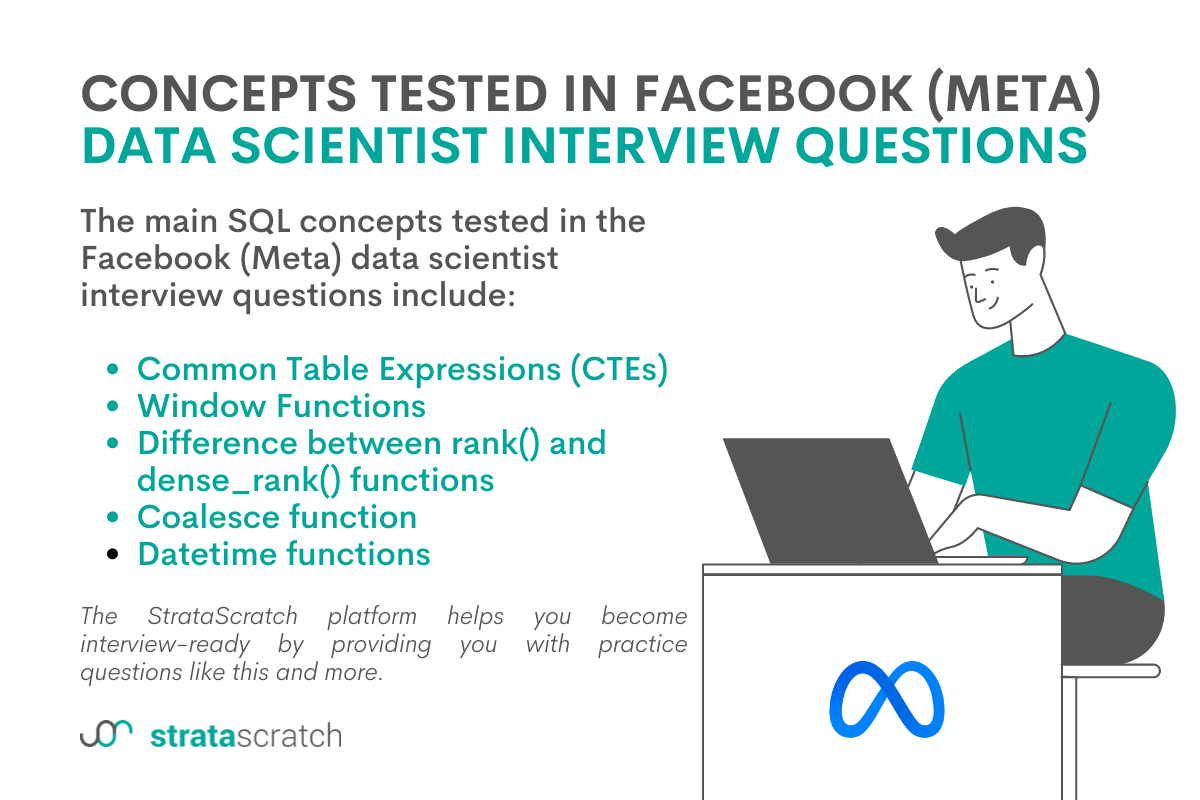
RANK()orDENSE_RANK(). Great for comparin’ rows, like findin’ top energy usage days across data centers. - CTEs (Common Table Expressions): These are like mini-tables you build in your query. Super handy for breakin’ down complex probs.
- Date/Time Functions:
DATEDIFF,YEAR, etc. Meta’s data often got timestamps, so you better know how to slice by date. - Groupin’ and Filterin’:
GROUP BY,HAVING,WHERE. They test if you can zoom into specific data chunks without messin’ up.
If any of these sound Greek to ya, don’t sweat it. We’ll get into how to prep next. Just know Meta mixes basic and advanced concepts to see if you’re a one-trick pony or the real deal.
How to Prep for Facebook SQL Interview Questions
Alrighty, you’ve seen the kinda questions Meta throws and the skills they’re after. But how do ya get ready so you don’t flop on the big day? I’ve got your back with some straight-up tips that worked for me and peeps I’ve mentored. Let’s break it into actionable steps:
1. Brush Up on SQL Basics (No Excuses!)
If you’re rusty on SQL, start with the fundamentals. I’m talkin’ SELECT, joins, aggregations—the bread and butter. You can’t fake this stuff in an interview. Meta might start with a softball question, and if you stumble, it’s game over. Use free online tutorials or platforms where you can practice queries hands-on. Get comfy with writin’ code that runs without errors.
2. Practice Real Meta-Style Problems
Don’t just do random SQL exercises. Hunt down problems that mimic Meta’s vibe—think user analytics, ad stats, social graphs. I’ve seen folks crush interviews ‘cause they practiced with datasets similar to what Meta deals with. Write queries for calculatin’ user retention or friend overlaps. The more you solve, the quicker you’ll spot patterns in their questions.
3. Master Advanced SQL Tricks
Meta loves sneakin’ in advanced stuff. Window functions, CTEs, handling nulls—get these down pat. For instance, learn how RANK() can help pick top records when there’s ties. I messed up once by ignorin’ these, thinkin’ basic SQL was enough. Big mistake. Spend a weekend geekin’ out on these topics; it’ll pay off.
4. Think Out Loud Durin’ the Interview
This one’s huge. Meta interviewers don’t just want the answer—they wanna see your brain at work. When I interviewed for tech roles, I’d narrate my steps: “First, I’m filterin’ for 2022 data, then groupin’ by user…” It shows you ain’t guessin’. Even if you mess up, they might nudge ya in the right direction if your logic’s solid.
5. Time Yourself on Practice Runs
Set a timer when practicin’. Meta interviews often got multiple questions, and you can’t spend 30 minutes on one query. Aim to sketch a solution in 5-10 minutes, then refine it. I used to take forever overthinkin’ stuff, but timin’ myself got me snappy without sacrificin’ accuracy.
6. Mock Interviews Are Your Friend
Grab a buddy or use online platforms for mock interviews. Nothin’ beats the pressure of someone watchin’ ya solve live. I did a few of these before my big tech interviews, and man, it helped calm the nerves. Plus, you get feedback on where ya ramble or skip steps.
Bonus Tip: Know Meta’s Biz a Lil’
Understand what drives Meta—ads, user engagement, connections. If a question’s about ad CTR, toss in a line like, “This helps optimize ad spend.” It shows you get their world, not just the code. I’ve seen interviewers light up when candidates connect tech to biz impact.
Common Pitfalls to Dodge
Before we wrap, lemme warn ya about some traps I’ve seen peeps fall into (heck, I’ve tripped over ‘em myself). Avoid these like the plague:
- Overcomplicatin’ Queries: Don’t write a 50-line monster when a 5-liner works. Meta values efficiency. Keep it clean.
- Ignorin’ Edge Cases: What if data’s missin’? What if there’s a tie? Think about weird scenarios. I once forgot to handle zero impressions in a CTR calc—looked like a rookie.
- Not Testin’ Your Code: If you can, mentally run your query on sample data. Does it spit out what you expect? I’ve caught dumb mistakes this way.
- Freezin’ Under Pressure: If you blank out, breathe. Say, “Lemme think this through.” They’d rather see ya recover than crash.
Why Crushin’ SQL at Meta Matters
Landin’ a role at Meta ain’t just a paycheck—it’s a badge of honor. Their data teams are at the forefront of tech, shapin’ how billions connect. Masterin’ these SQL questions shows you can handle scale, think sharp, and solve probs that impact the world. Plus, once you’re in, the learnin’ curve and network are unreal. I’ve seen folks go from Meta to launchin’ their own startups ‘cause of the skills they picked up.
Final Pep Talk, Fam
Look, preppin’ for Facebook SQL interview questions ain’t a walk in the park, but it’s doable. We’ve covered the why, the what, and the how—now it’s on you to put in the grind. Start small, practice daily, and don’t be scared to mess up. Every wrong query teaches ya somethin’. I believe in ya, and I know you got the chops to walk into that Meta interview and own it.
Got questions or wanna share your own Meta interview stories? Drop a comment below. And hey, if this helped, follow our blog for more unfiltered tech career tips. Let’s keep the convo goin’—together, we’re unstoppable!
What is a cursor?
In SQL, a cursor is a temporary memory or workstation. They store database tables, and in SQL there are two main types:
- Implicit cursors– Implicit cursors are allocated by the SQL server when users perform DML operations.
- Explicit cursors– Explicit cursors are based on user inputs.
How to Approach Meta SQL Interviews: Mindset + Strategy
Meta’s SQL interviews are not just about writing queries—they’re testing how you think through data problems in real time. Here’s exactly how to approach them:
1. Clarify before you code
- Always start by asking clarifying questions about metrics, data availability, and assumptions.
- Don’t assume the interviewer will provide missing information—you have to ask.
- If data gaps remain, state your assumptions explicitly.
2. Think in terms of business impact
- Before jumping into SELECT, ask yourself: “What decision will this query inform?”
- Relate metrics to user behavior, product KPIs, or operational efficiency.
- Your answer isn’t done until you’ve explained how the insight helps the business.
3. Prioritize query structure, then syntax
- First, explain the logical flow of your query (joins, filters, groupings) out loud.
- Then, code it.
- Meta interviewers care more about your structured approach than perfect syntax.
4. Preempt edge cases
- After coding, mention checks like: “I’ll add a WHERE condition to handle NULLs.”
- Bring up considerations like indexing columns for scalability.
- This shows foresight and practical awareness.
5. Stay calm with follow-ups
- Expect pushback like: “What if the dataset is 10x larger?” or “How would you optimize this?”
- Focus on high-level strategies (indexing, limiting data early, partitioning) instead of worrying about exact code changes.
SQL Interview Question | How to generate page recommendations for user based on friends likes | Meta
0