Hey there, future web dev rockstar! If you’re gearin’ up for a web developer interview, you’ve prolly got a mix of excitement and straight-up nerves I get it—I’ve been there, sweatin’ over whether I’d remember the diff between == and === under pressure But here’s the deal with the right prep, you can walk into that room (or Zoom call) feelin’ like you own the place. That’s why I’m droppin’ this mega guide on web developer interview questions. We’re gonna break it down simple, cover the big stuff first, and get you ready to impress. Let’s dive in!
Why Web Developer Interviews Can Be a Beast
Before we get to the nitty-gritty, let’s chat about why these interviews feel like a gauntlet Web development ain’t just one skill—it’s a whole toolbox You’ve got HTML for structure, CSS for makin’ things pretty, JavaScript for the magic, and then a bunch of frameworks, tools, and concepts like responsive design or security. Interviewers wanna see if you’ve got the basics locked down, if you can solve problems on the fly, and if you’re keepin’ up with the latest trends. So, we’re gonna tackle the most common questions, from beginner stuff to brain-teasers, and I’ll throw in some tips on how to answer like a pro.
Start with the Basics: HTML Questions
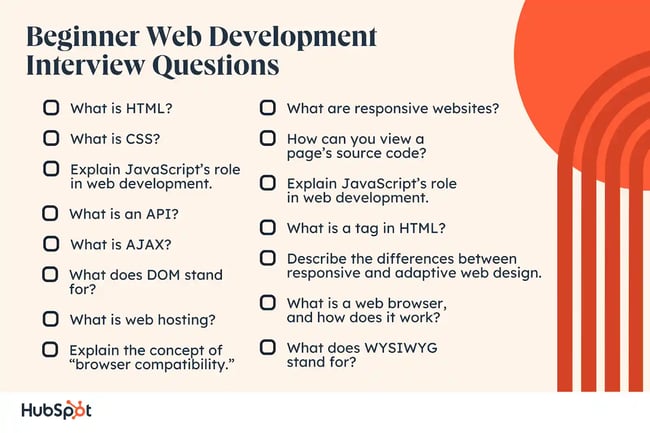
Let’s kick off with HTML, the backbone of any website If you’re interviewin’ for a front-end or full-stack gig, you can bet your bottom dollar they’ll ask about this Here’s some of the top questions I’ve seen pop up time and again
-
What is HTML, and why’s it important?
HTML stands for HyperText Markup Language, and it’s basically the skeleton of every web page out there. It uses tags to structure content—think headings, paragraphs, images, links. Without it, browsers wouldn’t know how to display stuff. When you answer, keep it clear: “HTML is the foundation of web pages, givin’ structure to content so browsers can render it right.” -
What are HTML tags, and can you name a few?
Tags are like instructions wrapped in angle brackets, usually comin’ in pairs like<p>for paragraphs or<a>for links. Some are solo, like<img>for images. Toss out examples like<h1>for big headings or<br>for line breaks to show you know your stuff. -
What’s the deal with semantic HTML elements?
These are tags that actually mean somethin’, like<header>,<footer>, or<article>. They ain’t just for looks—they help with accessibility and SEO by makin’ the page structure clear to both humans and machines. Say somethin’ like, “Semantic tags make your code readable and boost how search engines see your site.” -
Why do we use
<!DOCTYPE html>at the top?
This lil’ declaration tells the browser what version of HTML you’re usin’. In HTML5, it’s super simple, and it makes sure the page renders in standards mode, not some weird quirky mode. Just say, “It’s like settin’ the rules for how the browser reads your code—keeps everythin’ consistent.”
Pro tip: When answerin’ HTML questions, throw in a quick example if you can. It shows you ain’t just memorizin’—you get how it works.
Stylin’ It Up: CSS Questions
Next up, CSS—or Cascading Style Sheets. This is where you make a site look good, and interviewers wanna know if you can style without breakin’ a sweat. Here’s the hot list:
-
What’s CSS, and how’s it different from HTML?
CSS is all about presentation—colors, layouts, fonts. While HTML builds the structure, CSS dresses it up. I’d answer, “HTML is the bones, CSS is the skin. It controls how stuff looks across devices.” -
What’s the Box Model, and why’s it matter?
The Box Model is how CSS sees every element as a box with content, padding, border, and margin. It affects how much space an element takes up. Mess this up, and your layout’s toast. Explain it like, “Every element’s a box, and the model calculates its size with content plus padding, border, and margin. Get this wrong, and your design’s gonna look whack.” -
How do
paddingandmargindiffer?
Padding’s the space inside an element, between content and border. Margin’s outside, pushin’ other elements away. Keep it short: “Padding’s inner space, margin’s outer space. Easy peasy.” -
What’s the diff between Flexbox and Grid?
Flexbox is one-dimensional, great for alignin’ stuff in a row or column. Grid is two-dimensional, perfect for complex layouts with rows and columns. I’d say, “Flexbox is for simple alignment, Grid’s for full-on layout control. Both save ya from float headaches.”
When talkin’ CSS, mention responsiveness if ya can. It’s a buzzword interviewers love, and it shows you think about real-world use.
The Big Gun: JavaScript Questions
Alright, now we’re gettin’ to the meaty stuff—JavaScript. This is where web pages come alive, and it’s a fave for technical interviews. Be ready for these:
-
What is JavaScript, and what can it do?
JS is a high-level scripting language that adds interactivity to sites—think forms, animations, or fetchin’ data without reloadin’ the page. It’s huge for both front and back-end with stuff like Node.js. Say, “JavaScript makes sites dynamic. It’s behind clicks, updates, and even server-side apps.” -
Explain
let,const, andvar.
These are ways to declare variables, but they ain’t the same.varis old-school, function-scoped, and can be redeclared.letis block-scoped and updateable.constis block-scoped too, but ya can’t reassign it (though you can tweak objects inside it). Break it down: “varis outdated and messy,letlets ya update in a block,constlocks it down but still flexible with objects.” -
What’s the difference between
==and===?==checks value but flips types—like 5 equals ‘5’.===checks value and type, so 5 ain’t ‘5’. Always use===to avoid weird bugs. Tell ‘em, “==plays loose with types,===is strict. Stick with triple equals, trust me.” -
What’s a closure in JavaScript?
A closure happens when a function remembers variables from its outer scope, even after that scope’s gone. It’s dope for private data. Say, “Closures let inner functions hold onto outer variables. Super handy for keepin’ stuff hidden.”
JS questions often get tricky, so practice explainin’ with examples. If they ask for code, scribble somethin’ simple on a whiteboard or in a doc to show your thought process.
Frameworks and Libraries: React, Angular, Vue
If you’ve got framework experience on your resume, expect questions. React’s super popular, so let’s focus there, but I’ll touch on others too.
-
What is React, and why use it?
React’s a JavaScript library for buildin’ user interfaces with reusable components. It uses a virtual DOM to speed up updates. Answer with, “React lets ya build fast, modular UIs. The virtual DOM cuts down on slow updates, makin’ apps snappy.” -
What are props and state in React?
Props are data passed to components, like inputs. State is internal data a component manages itself. Keep it real: “Props come from outside, state’s inside. Change state, and your component updates.” -
What’s the virtual DOM, and how’s it help?
It’s a lightweight copy of the real DOM. React compares changes in the virtual DOM first, then updates only what’s needed in the real one. Say, “Virtual DOM’s like a draft. It figures out minimal changes, so updates don’t drag.”
If they ask about Angular or Vue.js, just know the basics: Angular’s a full framework with two-way binding, Vue’s lightweight and flexible. Don’t sweat if you ain’t an expert—focus on what you know best.
Back-End and Full-Stack Vibes
For full-stack roles, they might grill ya on back-end tech like Node.js or databases. Here’s a few to prep for:
-
What’s Node.js, and why’s it cool?
Node lets ya run JavaScript outside the browser, on servers. It’s event-driven and non-blocking, so it handles tons of requests fast. Say, “Node.js turns JS into a server beast. It’s async, so it scales like crazy for apps.” -
What’s the diff between SQL and NoSQL databases?
SQL is relational, with tables and strict schemas, like MySQL. NoSQL is flexible, like MongoDB, usin’ documents or key-value pairs. Explain, “SQL’s for structured data, think finance. NoSQL’s for messy, scalable stuff, like social apps.” -
What’s REST, and how’s it work?
REST is a style for APIs, usin’ HTTP methods like GET or POST to handle data. It’s stateless, meanin’ each request stands alone. Keep it chill: “REST makes APIs clean. Use GET to fetch, POST to send—simple client-server action.”
Back-end questions test if you get the big picture. Even if you’re front-end focused, knowin’ a bit of this shows versatility.
Modern Web Concepts You Can’t Ignore
Web dev ain’t stuck in 2010—interviewers wanna know if you’re up on trends. Here’s what’s hot:
-
What’s responsive design, and how do ya do it?
It’s makin’ sites look good on any device, from phones to desktops. Use flexible grids, media queries in CSS, and fluid images. Say, “Responsive design adapts to screens. Media queries and flex layouts are my go-to.” -
What are Progressive Web Apps (PWAs)?
PWAs are web apps that feel like native apps, with offline access and push notifications. Tell ‘em, “PWAs give app-like vibes on the web. They work offline and send alerts—pretty slick.” -
How do ya optimize a site for speed?
Compress images, minify CSS and JS, cut redirects, use a CDN, and load stuff async. I’d answer, “Speed’s king. Shrink files, cache stuff, and use a CDN to serve content fast.”
These show you ain’t just codin’—you’re thinkin’ about user experience and performance.
Security and Best Practices
Security’s a big deal, and messin’ up here can tank a project. Be ready for these:
-
Why’s HTTPS important?
It encrypts data between client and server, keepin’ stuff secure. Without it, data’s plain text—easy to steal. Say, “HTTPS locks down data with encryption. No-brainer for safety.” -
What’s CSRF, and how do ya stop it?
Cross-Site Request Forgery tricks users into unwanted actions on a site they’re logged into. Prevent it with tokens or SameSite cookies. Explain, “CSRF’s a sneaky attack. Tokens and cookie settings block it cold.” -
How do ya handle cross-browser compatibility?
Test on diff browsers, use prefixes for CSS, and lean on frameworks like Bootstrap. Answer, “I test everywhere, use vendor prefixes, and tools like ‘Can I Use’ to stay safe.”
Soundin’ confident on security shows you take responsibility serious.
Soft Skills and Problem-Solvin’
Tech ain’t all they care about—they wanna know how ya think and work. Expect stuff like:
-
How do ya approach a tough bug?
Say you break it down: reproduce the issue, check logs, isolate the cause, test fixes. I’d go, “I recreate the bug, dig into logs, and test small changes ‘til it’s fixed. Patience wins.” -
Why’s version control like Git important?
It tracks changes, lets teams collab, and saves ya if somethin’ breaks. Say, “Git’s a lifesaver. It logs every edit, so I can rollback or merge without chaos.” -
How do ya stay updated in web dev?
Mention readin’ blogs, followin’ devs on Twitter, or takin’ courses. Keep it real: “I’m always on blogs or Twitter for trends. Gotta keep learnin’ or ya fall behind.”
These show you’re a team player who don’t stop growin’.
How to Prep Like a Champ
Alright, you’ve got the questions—now how do ya get ready? Here’s my game plan for crushin’ it:
- Practice Answers Out Loud: Don’t just read—say ‘em. It helps ya sound natural, not rehearsed.
- Code Every Day: Build small projects or solve challenges on sites like Codewars. Hands-on beats theory.
- Mock Interviews: Grab a buddy or use online tools to sim an interview. Pressure tests ya.
- Know Your Resume: If ya listed React, be ready to talk it. Don’t bluff—they’ll catch ya.
- Stay Calm, Yo: Nerves happen, but breathe deep. They wanna see how ya think, not just right answers.
I’ve flubbed interviews before by overthinkin’. Keep it chill, be honest if ya don’t know somethin’, and say, “I’d look that up and learn it quick.” Shows humility and grit.
Wrappin’ It Up: You Got This!
Look, web developer interviews can feel like a marathon, but with these questions in your back pocket, you’re already ahead of the game. From HTML basics to JavaScript quirks, CSS layouts to security smarts, we’ve covered the biggies. Remember, it ain’t just about knowin’ stuff—it’s about showin’ you can learn, adapt, and solve probs. So, go over these, practice your answers, and walk in there with swagger. You’ve worked hard to get here, and I’m rootin’ for ya. Drop a comment if you’ve got other questions or wanna share your interview wins—I’m all ears! Let’s land that dream gig together!
3 Explain the concept of virtual DOM in React. How does it improve performance?

Virtual DOM is a lightweight representation of the actual DOM in memory. When there are changes to the state of a React component, a new virtual DOM is created, and the difference between the new and old virtual DOMs is calculated. Only the necessary changes are then applied to the actual DOM, resulting in faster updates and improved performance compared to directly manipulating the DOM.
4 What is Git and why is it used?
Git is a distributed version control system used to manage and track changes in source code. It enables multiple developers to work on a project simultaneously without overwriting each others changes, ensuring efficient collaboration and version control. Key features include branching and merging, which allow developers to work on different features or fixes independently and then integrate their work into the main codebase. This helps maintain a history of changes, facilitates rollback to previous versions if needed, and supports collaborative workflows.
Web Developer Interview Questions and Answers | Web Development Interview Preparation | Edureka
0