Hey there, fellow code wranglers! If you’re gearin’ up for a web development interview, I’m guessing you’ve got a mix of excitement and straight-up nerves right now Been there, done that! I remember my first big interview—sweaty palms, second-guessing every darn thing I knew about HTML. But here’s the deal preparation is your best buddy At our lil’ corner of the internet, we’re all about helpin’ you nail that dream gig. So, I’ve put together this mega guide on web development interview questions to get you ready to shine.
We’re gonna dive into the nitty-gritty of what interviewers throw at you—whether you’re a fresh face or a seasoned coder with a few battle scars. From HTML basics to fancy-pants JavaScript tricks, I’ve got your back. Let’s break it down nice and easy, with tips on how to answer like a pro. Grab a coffee (or a Red Bull, no judgment), and let’s get crackin’!
Why Web Dev Interviews Matter
Before we jump into the questions lemme tell ya why prepping for these interviews ain’t just about spittin’ out answers. Web development is a crazy-hot field right now. Companies are huntin’ for folks who can build slick websites handle backend magic, and keep up with the latest tech. Your interview ain’t just a test of knowledge—it’s a chance to show you can solve problems, think on your feet, and vibe with the team.
Most interviewers wanna see three things
- Core Skills: Do you know your HTML from your CSS, your JavaScript from your Java?
- Problem-Solving: Can you tackle a weird bug or explain a tricky concept?
- Fit: Are you someone they’d wanna work with every day?
So, as we go through these questions, I’ll toss in some advice on how to frame your answers to hit all those points. Cool? Let’s roll!
HTML: The Foundation of Web Dev
Let’s start with the basics. HTML is like the skeleton of every website, and interviewers love kickin’ things off here, especially for entry-level roles.
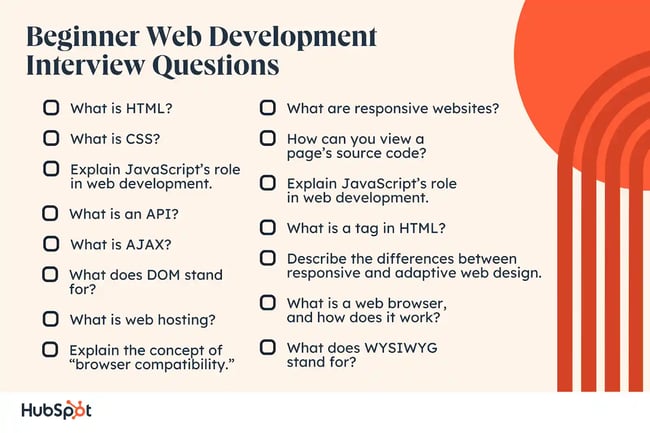
1. What is HTML, anyway?
HTML stands for HyperText Markup Language. It’s the standard way to create web pages, usin’ tags and attributes to structure stuff like headings, paragraphs, images, and links. Think of it as tellin’ the browser, “Hey, put a title here, a picture there.” Without HTML, you’ve got no foundation for your fancy designs or interactive bits.
How to Answer: Keep it simple. Say it’s the backbone of web content, usin’ tags to define structure. Maybe mention it works hand-in-hand with CSS for style and JavaScript for action.
2. What are HTML tags?
HTML tags are lil’ keywords wrapped in angle brackets—like <p> for paragraphs or <img> for images. Most come in pairs (openin’ and closin’), tellin’ the browser how to display what’s inside. Some, like <br> for a line break, are solo acts and don’t need a partner.
How to Answer: Explain they’re instructions for the browser. Drop an example like <h1> for a big heading and mention self-closing tags to show you know the quirks.
3. What’s the deal with semantic HTML elements?
Semantic HTML tags—like <header>, <footer>, or <article>—actually mean somethin’ to both humans and machines. They ain’t just for looks; they help with accessibility (think screen readers) and SEO (search engines love ‘em). Usin’ <nav> for navigation tells everyone what that section’s purpose is.
How to Answer: Say they add meanin’ to your code, makin’ it easier for developers, browsers, and search engines to understand. Toss in an example like <aside> for side content.
4. Why do we need <!DOCTYPE html> at the top?
This lil’ declaration tells the browser what version of HTML you’re usin’. In HTML5, it’s super short: <!DOCTYPE html>. It makes sure the browser renders your page in “standards mode,” avoidin’ weird quirks or inconsistencies across different browsers.
How to Answer: Keep it straight—say it’s a signal to the browser for proper rendering. Mention it goes right at the top, before the <html> tag.
CSS: Stylin’ Up Your Pages
Movin’ on to CSS, or Cascading Style Sheets. This is where you make your site look pretty—or at least not like a 90s Geocities page. Interviewers wanna know you can style stuff without breakin’ the layout.
5. What is CSS, and why’s it important?
CSS is all about presentation. It controls how your HTML elements look—colors, fonts, layouts, the whole shebang. It lets you separate content from design, so you can tweak a site’s vibe without messin’ with the structure. Plus, it’s key for responsive design, makin’ sure your site looks dope on phones and desktops alike.
How to Answer: Say it’s the tool for stylin’ web pages, givin’ control over visuals. Highlight how it keeps design separate from content for easier updates.
6. How do you add CSS to a webpage?
There’s three main ways to slap CSS onto your site:
- Inline CSS: Stick a
styleattribute right in your HTML tag, like<p style="color: red;">Hey!</p>. Quick but messy for big projects. - Internal CSS: Put a
<style>tag in the<head>section of your HTML. Good for small stuff, keeps it in one file. - External CSS: Link a separate
.cssfile with<link rel="stylesheet" href="styles.css">. Best for big sites—clean and reusable.
How to Answer: List all three, explain when to use each. Say external is the go-to for pros ‘cause it’s organized.
7. What’s the CSS Box Model?
Every element on a page is like a lil’ box, and the Box Model explains how it’s built. It’s got four layers:
- Content: The actual stuff, like text or images.
- Padding: Space around the content, inside the border.
- Border: The edge around padding and content, can be styled.
- Margin: Space outside the border, pushin’ other elements away.
Total size of an element? Add up content, padding, border, and margin. Mess this up, and your layout’s toast.
How to Answer: Break it into the four parts. Maybe mention how forgettin’ margins can make stuff overlap if you’re not careful.
8. What’s the diff between class and id in CSS?
Here’s a quick rundown in a table ‘cause I know y’all love visuals:
| Feature | Class Selector | ID Selector |
|---|---|---|
| Syntax | Starts with a dot, like .btn |
Starts with a hash, like #header |
| Usage | Can style multiple elements | Targets one unique element |
| Specificity | Lower priority in conflicts | Higher priority, overrides class |
| Example | .nav-link { color: blue; } |
#logo { width: 100px; } |
How to Answer: Say classes are for reusin’ styles across elements, while IDs are for one-off stuff. Mention IDs got more “power” in specificity battles.
JavaScript: Bringin’ Sites to Life
JavaScript (JS) is where the magic happens—interactivity, dynamic content, all that jazz. Interviewers dig deep here ‘cause it’s a must-have skill.
9. What is JavaScript, and why’s it a big deal?
JavaScript is a scripting language that makes websites interactive. Think form validation, animations, or fetchin’ data without reloadin’ the page. It’s a core part of web dev, runnin’ in browsers and even on servers with Node.js. Without JS, the web would be a boring, static place.
How to Answer: Call it the engine for dynamic web stuff. Mention it’s versatile—frontend, backend, everywhere.
10. What’s the difference between let, const, and var?
Another table comin’ at ya for clarity:
| Feature | let |
const |
var |
|---|---|---|---|
| Reassignment | Can change value | Can’t change value | Can change value |
| Scope | Block-scoped | Block-scoped | Function or global scope |
| Hoisting | Not hoisted | Not hoisted | Hoisted, can cause bugs |
| Example | let x = 5; x = 10; |
const y = 5; (no change) |
var z = 5; z = 10; |
How to Answer: Explain let and const are modern, safer choices ‘cause of block scope. Say var is old-school and can mess up with hoisting.
11. What’s the DOM, and why should I care?
The DOM, or Document Object Model, is like a tree structure of your web page. Every tag, attribute, and text bit is a node in this tree. JavaScript uses the DOM to mess with the page—change text, add elements, whatever. It’s how you make stuff happen after the page loads.
How to Answer: Describe it as a map of the webpage JS can edit. Give a quick example, like changin’ a button’s text with document.getElementById().
12. What are closures in JavaScript?
Closures are a bit of a brain-twister, but stick with me. It’s when a function “remembers” the variables from its outer scope, even after that outer function is done. Imagine a lil’ function inside another, holdin’ onto data like a backpack. Super handy for private variables or settin’ up event handlers.
How to Answer: Use a simple analogy like a backpack. Say it’s useful for data privacy, and drop a quick code snippet if you’re feelin’ fancy.
Frameworks and Tools: The Modern Web
Now we’re gettin’ into the trendy stuff. Frameworks like React or Angular, and tools like Node.js, are hot topics for mid-to-senior roles.
13. What is React, and why’s everyone obsessed?
React is a JavaScript library for buildin’ user interfaces, pushed by Facebook. It’s all about components—lil’ reusable chunks of UI. It uses a virtual DOM to update only what’s changed, makin’ apps fast as heck. Companies love it ‘cause it’s great for dynamic, single-page apps.
How to Answer: Say it’s for buildin’ fast, modular UIs. Mention the virtual DOM as a speed booster, and how it’s popular for modern web apps.
14. What’s Node.js, and how’s it different from browser JS?
Node.js lets you run JavaScript outside the browser, on servers. It’s built on the V8 engine (same as Chrome) and uses an event-driven, non-blockin’ model to handle tons of tasks at once. Unlike browser JS, it’s for backend stuff—buildin’ APIs, handlin’ file systems, you name it.
How to Answer: Explain it’s JS for servers, not just browsers. Highlight it’s async nature for scalability, like handlin’ thousands of requests.
15. What’s the difference between SQL and NoSQL databases?
Here’s a quick comparison ‘cause databases always pop up:
| Feature | SQL Databases | NoSQL Databases |
|---|---|---|
| Structure | Tables with rows/columns | Flexible, like JSON docs |
| Schema | Strict, predefined | Dynamic, can change |
| Scalability | Vertical (bigger server) | Horizontal (more servers) |
| Examples | MySQL, PostgreSQL | MongoDB, Cassandra |
How to Answer: Say SQL is for structured, relational data (like banks), while NoSQL is for flexible, scalable stuff (like real-time apps).
General and Behavioral Questions
Interviewers ain’t just about tech—they wanna know how you think and work.
16. How do you handle cross-browser compatibility?
This is a real-world pain. I usually start with feature detection to check if a browser supports somethin’. Then, I use vendor prefixes for CSS quirks and polyfills for missin’ features. Testin’ on multiple browsers is a must—don’t just assume it works on Chrome! Tools like BrowserStack help a ton.
How to Answer: List practical steps—detection, prefixes, testin’. Say you prioritize user experience over fancy features if push comes to shove.
17. Tell me about a tough project you worked on.
This ain’t a tech question, but it’s huge. I’d talk about a time I built a responsive e-commerce site under a tight deadline. Had to juggle buggy APIs, client changes, and mobile glitches. I broke tasks into chunks, used Git for version control, and pulled all-nighters. End result? Site launched on time, client was thrilled.
How to Answer: Pick a real or made-up story. Focus on challenges, your actions, and the win. Show problem-solvin’ and teamwork.
Advanced Concepts for Senior Roles
If you’re aimin’ for a senior gig, expect deeper questions. Let’s hit a few.
18. What are JavaScript Promises?
Promises are a way to handle async stuff in JS, like fetchin’ data. They’re objects that represent a future result—either success or failure. You’ve got states like “pending,” “fulfilled,” or “rejected.” They’re cleaner than callbacks, avoidin’ that nasty “callback hell.”
How to Answer: Explain they manage async tasks. Mention states and how they’re better than nested callbacks for readability.
19. What’s REST, and how’s it used?
REST, or Representational State Transfer, is a style for designin’ APIs. It uses HTTP methods like GET (read), POST (create), PUT (update), and DELETE (yep, delete) to mess with resources. Each resource gets a URL, and requests are stateless—meanin’ the server don’t remember past chats.
How to Answer: Call it a blueprint for APIs. Mention HTTP methods and statelessness as key ideas, with a nod to real-world use in web apps.
20. Explain Virtual DOM in React.
Virtual DOM is React’s secret sauce. It’s a lightweight copy of the real DOM in memory. When somethin’ changes, React builds a new virtual DOM, compares it to the old one, and only updates the real DOM where needed. Cuts down on slow, full-page refreshes.
How to Answer: Say it’s a performance hack. Walk through the diff-and-update process, and why it makes React apps snappy.
Tips to Ace Your Interview
Alright, we’ve covered a heap of questions, but lemme drop some extra wisdom on how to stand out:
- Practice Explainin’: Don’t just know the answer—practice sayin’ it out loud. If you stumble on “What’s a closure?” in front of a mirror, you’ll trip up in the interview.
- Show Curiosity: Ask questions back. Like, “What kinda projects would I be workin’ on?” It shows you’re engaged.
- Admit Gaps: If you don’t know somethin’, say, “I ain’t sure, but here’s how I’d figure it out.” Honesty beats BS every time.
- Code on the Spot: Be ready for live codin’. Keep calm, talk through your logic, even if your stuck.
Common Pitfalls to Dodge
I’ve seen folks (and heck, I’ve been there) mess up interviews with avoidable stuff:
- Ramblin’: Keep answers tight. Don’t spend 10 minutes on “What is HTML?” unless they ask for depth.
- Forgettin’ Basics: Senior or not, brush up on fundamentals. Trippin’ over block vs. inline elements looks bad.
- No Personality: Don’t be a robot. Crack a smile, throw in a lil’ humor if it fits. They’re hirin’ a human, not a code machine.
Wrappin’ It Up
Phew, we’ve been through a lot, huh? Web development interviews can feel like a gauntlet, but with these questions under your belt, you’re way ahead of the game. From HTML tags to React’s virtual DOM, you’ve got a roadmap to tackle whatever they throw at ya. Remember, it ain’t just about knowin’ stuff—it’s about showin’ you can learn, adapt, and fit in.
I’ve messed up interviews before, trust me. Forgot what this meant in JavaScript once—felt like an idiot. But each flop taught me somethin’. So go in there, be yourself, and if you don’t know an answer, own it and pivot to what you do know. We’re rootin’ for ya at our lil’ blog corner. Drop a comment if you’ve got other questions or wanna share your interview war stories. Now, go crush it!
What is the purpose of the <!DOCTYPE html> declaration?
The declaration defines the document type and version of HTML being used. It helps the browser to correctly render the content by switching it into standards mode, which ensures consistent behavior across different browsers. In HTML5, the declaration is simplified to , signaling to the browser that the document is an HTML5 document. It is placed at the very top of the HTML document, before the tag.
4 What is Git and why is it used?
Git is a distributed version control system used to manage and track changes in source code. It enables multiple developers to work on a project simultaneously without overwriting each others changes, ensuring efficient collaboration and version control. Key features include branching and merging, which allow developers to work on different features or fixes independently and then integrate their work into the main codebase. This helps maintain a history of changes, facilitates rollback to previous versions if needed, and supports collaborative workflows.
WEB DEVELOPER Interview Questions And Answers! (How to PASS a Web Development Job Interview!)
FAQ
What are common web dev interview questions?
- What were your responsibilities in your previous role as a Web Developer? …
- What programmeming languages do you have experience with? …
- Has a client ever been unhappy with your work? …
- What do you do to reduce the loading time of a web page? …
- Would you recommend HTTP 2.0 or HTTP 1.1?
How do I prepare for a web developer interview?
Try to learn about accessibility, responsive design, and how to create intuitive interfaces. Research the Company: Show some interest in the company you’re interviewing with by learning about their business and products. Prepare some questions to ask during the interview to show you care about the role.
What are the 7 stages of web development?
- Phase 1. Briefing. What is briefing. Example of Briefing.
- Phase 2. Analysis of the information.
- Phase 3. Planning.
- Phase 4. Design and prototyping.
- Phase 5. Web content.
- Phase 6. Web development.
- Phase 7. Testing and launch.